Your Website Should Know Where Your Visitor Came From
An SMB owner spending $5,000 a month on Google Ads, Facebook, and email marketing has the same urgent question every month: which channel actually drove the calls?
If you’ve ever asked that question and not had a real answer, you’re in the majority. Most SMBs running paid ads can’t tell you, with any confidence, which channel is producing their leads. They run the campaigns, they get calls, they hope the right channels are working, and they reallocate budget based on vibes.
The gap isn’t a tooling gap. The tools exist. The gap is an economic one — the enterprise-grade tools that solve this problem cost more than most SMBs can justify, and the cheap-or-free alternatives don’t actually work.
There’s a third path, and I want to walk through it because it’s the kind of practical, decidedly-not-AI infrastructure that most SMB marketers either don’t know about or know about but can’t implement themselves.
How most SMBs do attribution today (badly)
Here’s what most SMB websites look like for a visitor: one phone number, displayed prominently in the header, footer, and contact page. Same number whether you arrived from Google Ads, an organic Google search, a Facebook ad, a referral from a partner site, or your customer’s email signature.
When that number rings, the SMB has no idea where the call came from. They might ask the caller (“How did you hear about us?”) — and 60% of callers will give a wrong or vague answer, because most people don’t remember which ad they clicked on. The rest will say “I just Googled you,” which conflates organic search, branded paid search, and the directory listing that someone clicked through three days ago.
The attribution data is gone. The ad spend keeps flowing. The channels that don’t work keep getting funded because nobody can prove they don’t work, and the channels that do work might get under-funded because they’re not obvious.
This isn’t an edge case. This is the default state for the vast majority of small businesses running paid acquisition.
The enterprise answer (and why SMBs can’t afford it)
The technical fix is dynamic call tracking. Services like CallRail, ServiceTitan’s call tracking, or Invoca issue you a unique phone number per marketing channel. A visitor arriving from Google Ads sees one number; a visitor from Facebook sees a different one; an organic visitor sees a third. Calls to each number are logged with the originating source and forwarded to your actual business line.
This works. It’s the right architecture. It’s also priced for enterprise:
- CallRail starts around $45/month plus per-number and per-minute charges. Real-world cost for a multi-channel SMB: $60–100/month per location.
- For an agency running ten client sites with five tracked channels each, that’s 50 numbers. The monthly attribution bill exceeds the entire monthly ad budget for several of those clients.
- The economics break for businesses spending less than $5,000/month on ads, which is most local SMBs.
The result: SMBs either pay enterprise prices for a tool whose ROI doesn’t pencil out, or — far more commonly — they don’t bother and accept the attribution gap.
A third path: UTM-driven dynamic content
There’s a technique that’s been technically possible for over a decade but is almost never implemented at SMB scale: read the inbound UTM parameters from the URL and swap elements of the page based on what they say.
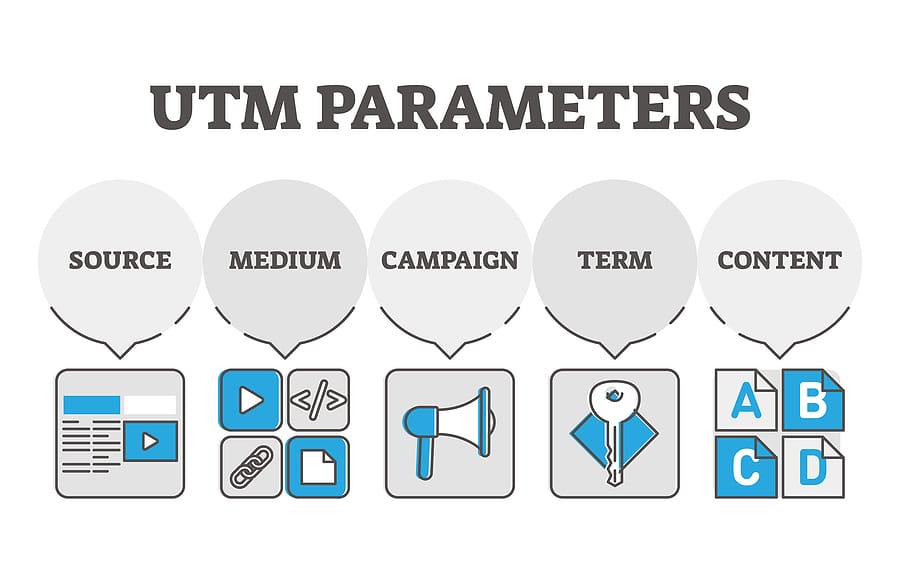
Here’s the trick. Every time a paid ad sends a visitor to your site, the URL carries tracking parameters appended to it:
yoursite.com/?utm_source=google&utm_medium=cpc&utm_campaign=spring-saleThose parameters are sitting right there in the browser address bar. Any JavaScript on the page can read them. Any HTML element on the page can be rewritten based on what they say. The infrastructure to do this is built into every modern browser. The challenge isn’t capability — it’s that nobody implements it as a turnkey solution for SMBs.
Here’s what you can do with it:
- Phone number swap. A visitor arriving with
utm_source=googlesees one tracked phone number;utm_source=facebooksees a different one. The numbers route to your same business line but each forwards through a different gateway that logs which number was dialed. Now you have attribution. - Email address swap. Same trick, applied to
mailto:links. Inquiries via the Google Ads version of your site come into[email protected]; Facebook inquiries come into[email protected]. Email automation can route from there. - Content swap. This is where it gets interesting. The hero text on your page, the CTA wording, the testimonial showcased — any of it can change based on the source channel. A visitor from a Facebook video ad sees a different hero than a visitor from a Google Search “near me” query, because those two visitors are coming with materially different intent.
- Attribution dashboard. All of the above generates source-tagged events you can capture server-side. Suddenly you have a reporting layer that tells you which channels produced which call volumes, which email leads, which form submissions.
None of this requires AI. None of this requires a SaaS subscription. The only thing it requires is a WordPress plugin (or equivalent) that reads UTM parameters and rewrites the page. It’s plumbing — boring, valuable plumbing.
The implementation I’ve built
This is what Local-Value-UTM-Manager does. It’s a WordPress plugin running on production sites today.
Version 1 (live):
- Reads inbound
utm_source,utm_medium,utm_campaignfrom the URL on page load. - Looks up a per-site mapping (configured via an admin UI) to determine which phone number to display.
- Rewrites every
tel:link and visible phone number on the page in real time. - Each unique tracked number is a separate attribution lane.
Version 2 (in active development):
- Email address swap (mailto: rewriting per channel).
- Content block swap — hero text, CTA, testimonial variants per source.
- Server-side analytics capture and reporting dashboard.
- Optional integration with the Zoho CRM pipeline already running for localvalue.co, so attribution flows straight through to lead records.
Cost to the SMB: zero recurring SaaS spend. The plugin lives on their site, replaces a per-number recurring charge with a one-time build/configuration cost.
When this beats CallRail-style services, and when it doesn’t
I’m being deliberate about not overclaiming. The dynamic-content approach has limits.
Where it wins:
- SMBs with multiple traffic channels who can’t justify $60–100/month per location for CallRail.
- Agencies managing many client sites who’d be paying that per-location bill many times over.
- Multi-site networks like the localvalue.co WordPress multisite, where one plugin instance serves the whole network with per-site configuration.
- Anyone who wants the ability to extend beyond phone numbers to content, CTAs, and lead capture without integrating yet another vendor.
Where CallRail-style services still win:
- If you need call recording, transcription, and conversation intelligence at the level CallRail or Invoca offer, the SaaS services are doing a lot more than just number swapping. Their AI-driven call analytics are genuinely useful when you have the call volume to justify it.
- If you need multi-step IVR routing based on the originating channel, the SaaS path is more straightforward.
- If you’re running a high-volume call center where every call is a transaction, the dollars-per-call economics flip and SaaS makes more sense.
For a SMB with two or three locations spending under $10K/month on ads, the dynamic-content approach is the right tool. For a 50-location franchise running a national campaign, CallRail probably still wins.
Why I’m writing about this
A theme that keeps showing up in my consulting work: SMBs and the agencies that serve them have been told for years that the only way to do “real” attribution is to buy an enterprise SaaS. So they either buy it and watch it eat their ad budget, or they don’t buy it and operate blind. Neither option is good.
The third path — UTM-driven dynamic content via a WordPress plugin — has been technically available for years. The reason it hasn’t proliferated isn’t technical; it’s that nobody productized it as a turnkey SMB solution. Building one in-house took me a few weeks because I needed it for my own work and my clients’ work. There’s no reason it shouldn’t exist as a category.
This connects to a broader theme I keep returning to: Why Most SMBs Are Doing AI Wrong. The point of that piece was that AI gets applied where it isn’t the right tool, and rules-based plumbing gets ignored because it’s not glamorous. UTM Manager is the inverse story — a non-AI WordPress plugin that solves a real SMB problem better than the AI-laden enterprise alternatives, because the problem doesn’t need AI.
Pick the right tool for the job. Some jobs need AI. Some jobs need a 200-line PHP plugin that reads URL parameters. Knowing which is which is the actual consulting skill.
What you can do with this
If you’re an SMB running paid ads and you’ve been operating without attribution:
- Implement something. Even if it’s not my plugin — even if it’s a one-off custom build, or a budget call-tracking tool, or just adding UTM parameters to every ad campaign and checking GA4. Operating without attribution is operating blind, and the channels you can’t measure are the ones you’ll over- or under-fund.
- Be honest about the call recording trade-off. If you genuinely need call recording and transcription, the SaaS services do more than UTM swapping can. Don’t pretend you don’t need it if you do.
- Don’t over-engineer. A simple “tracked phone number per channel” implementation captures 80% of the attribution value at <10% of the cost of a full enterprise stack. Start there.
If you’re an agency serving SMB clients: the math on per-client attribution overhead is brutal. A WordPress plugin you control beats per-client SaaS subscriptions almost every time once you’re managing more than three clients. Build, license, or buy one — but don’t keep paying enterprise prices for SMB problems.
If you’d like help thinking through your specific attribution stack, that’s exactly the kind of conversation I have with Local Value Marketing consulting clients. Get in touch.